Skip to content
  • 0 Votes
    1 Posts
    38 Views
    No one has replied
  • software licensing question

    Ask your questions right here!
    1
    0 Votes
    1 Posts
    41 Views
    No one has replied
  • Battery Data Collection

    Stinger Vision FPV
    4
    0 Votes
    4 Posts
    90 Views
    Vipul BansalV
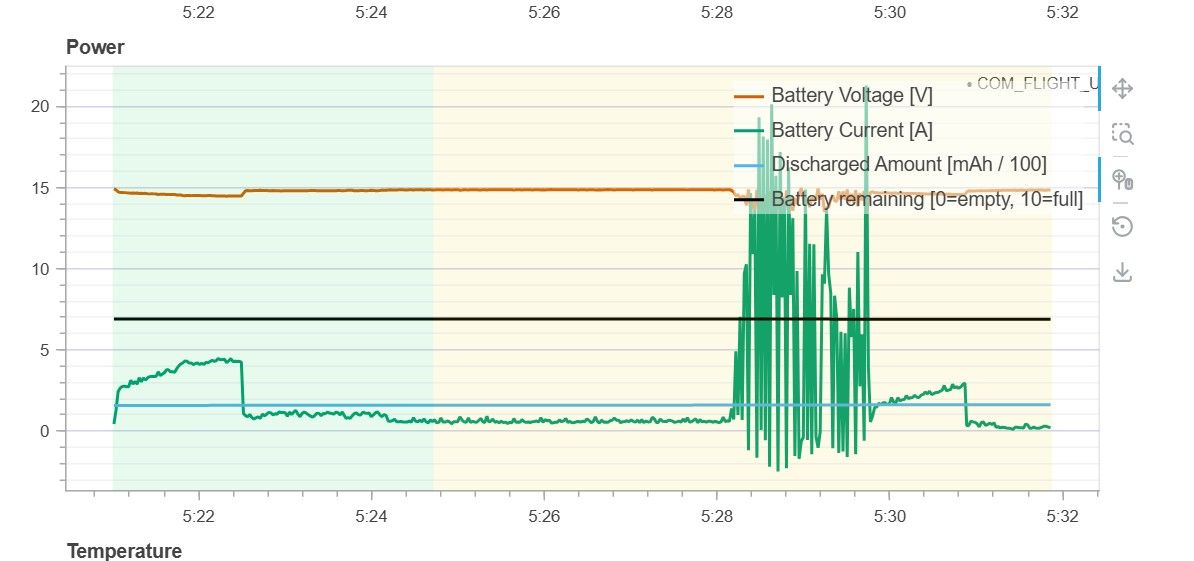
    I want to develop a battery management system to read live battery data and use it into a software that plans launch, path, return and control of the drone
  • 0 Votes
    9 Posts
    384 Views
    Eric KatzfeyE
    I was finally able to get to a Windows PC and try this. I still cannot recreate the issue. I can restart voxl-ardupilot with systemctl restart or via Mission Planner reboot pixhawk and in both cases I can disconnect and then reconnect Mission Planner to ardupilot. I am connected on VOXL2 to my local WiFi network via station mode. I have disabled all other services other than, essentially, voxl-ardupilot and voxl-mavlink-server. I am using recent VOXL2 SDK, recent ArduPilot build, and Mission Planner 1.3.83
  • OpenVINS

    GPS-denied Navigation (VIO)
    2
    1
    0 Votes
    2 Posts
    97 Views
    zauberflote1Z
    Please update your VINS to our master branch here: https://gitlab.com/voxl-public/voxl-sdk/services/voxl-open-vins-server For epoch-synced cams, tracking AR0144, please use: https://gitlab.com/voxl-public/voxl-sdk/services/voxl-open-vins-server/-/tree/synced-timestamp?ref_type=heads
  • Using VOXL IO Expander with VOXL 2 Mini?

    Ask your questions right here!
    2
    0 Votes
    2 Posts
    77 Views
    Eric KatzfeyE
    Yes, you can connect to one of the UARTs on J19. However, there are only 3 UARTs so you'll have to choose which one to use. The PWM outputs on the IO expander are mainly intended to be used when you have PWM ESCs instead of a ModalAI UART based ESC. In that case you would connect to the ESC UART. If you want to use the IO expander in addition to a ModalAI UART based ESC then you will have to choose between the RC UART or the GNSS UART.
  • QDL - 'received non-successful result'

    Sentinel
    2
    0 Votes
    2 Posts
    484 Views
    P
    RMA'd the VOXL2 board, it was found to be unrepairable.
  • 0 Votes
    2 Posts
    124 Views
    D
    Hi @masa-chau, It seems you are on the right track. A few pointers from my side: First, what are you actually trying to achieve? If you can avoid tracking in 3D and perform the task in 2D, I would strongly recommend doing that. Recovering 3D position from 2D observations is quite hard and can be very finicky/unreliable. For many tracking tasks, you can get away with tracking entirely in image space. If you really need to track in 3D: Use the PX4 estimator output. VIO is fused into EKF2 in PX4, so I would probably use the PX4 estimated poses/velocities as the state of the drone rather than trying to fuse the raw VIO yourself. I believe these should be available in ROS 2 through voxl-microdds-agent, although someone from ModalAI should confirm the exact topics/data being exposed. Your 2D observations from the object detector are fine, but pay close attention to latency. Also, I would not expect reliable detection at very long distances with the Starling 2 Max fisheye camera; in practice, the useful detection range may be significantly below what you might initially expect. I would not rely on the ToF camera for this. For the actual tracking algorithm, I would look at an EKF or MAP estimator that fuses the 2D observations (e.g. bearing and potentially bounding-box size) with the drone's 3D pose/velocity. The important point is that a single 2D observation does not give you reliable depth. To estimate the object's distance over time, you need additional constraints, typically through a motion model or assumptions about how the tracked object moves. Whether the object is flying or driving, you will probably need to make some approximation about its motion. I would look into the existing literature on monocular 3D object tracking / bearing-only tracking for this part. Good luck!
  • 0 Votes
    1 Posts
    48 Views
    No one has replied
  • 0 Votes
    9 Posts
    385 Views
    VinnyV
    Hi @jetson-nano I'm not sure I am following. The ADB Debug port is still available on VOXL 2 when you use an M0062 Debug Board with USB Hub. Our plug-in boards that connect to J3 and J5 do not consume the primary USB. See here for guidance: https://docs.modalai.com/expansion-design-guide/#usb-expansion-over-j3--j5
  • 0 Votes
    3 Posts
    148 Views
    M
    ok thanks, I have emailed, please let me know if you have not received it
  • 0 Votes
    1 Posts
    69 Views
    No one has replied
  • 0 Votes
    4 Posts
    154 Views
    Eric KatzfeyE
    Can you plug the cable from the working drone into the other one? That could tell you if it's the cable.
  • stinger + TOF

    Stinger Vision FPV
    1
    0 Votes
    1 Posts
    84 Views
    No one has replied
  • 0 Votes
    1 Posts
    158 Views
    No one has replied
  • 0 Votes
    3 Posts
    179 Views
    Eric KatzfeyE
    Also, there are many good simulators out there.
  • ToF v2 outdoor noise

    Image Sensors
    15
    3
    0 Votes
    15 Posts
    4k Views
    P
    @MattK This is a generalized question but did your Starling Max 2 come with a ToF?
  • Running 4 Ar0144s on M0188

    VOXL 2 Mini
    12
    1 Votes
    12 Posts
    1k Views
    Alex KushleyevA
    Yes, I believe the system image v1.8.08 has all the above changes built applied. Easy way to confirm voxl-camera-server -l and check the printed min gain. it should be 100 not 54. if you see 100, then you have the latest com.quite.tuned.default.bin exposure control improvements should also be in there as of v1.8.05 (com.qti.sensor.ar0144.so). this is harder to test, but sdk 1.6.5 should have the latest. To test, cover up the camera to drive the exposure and gain to the max and then uncover and you should observe smooth transition, no jumps in image brightness. it looks like we are not shipping com.qti.sensormodule.ar0144_fsin_3.bin in the system image right now, but like i mentioned earlier we are moving towards putting the camera drivers into the voxl-camera-server repository.. but for now you will need to manually copy that one. Alex
  • 0 Votes
    2 Posts
    151 Views
    zauberflote1Z
    @Noah-Heinen Hello there, Yes, we haven't officially supported this package for a while, and our development drones currently do not ship STEREO_RAW8 format by default. However, even though there are no official plans for this repo, I made some changes that should solve the issue for now. This also expands to RAW8 images. Feel free to test it out, this repo will likely become community driven.
  • 0 Votes
    2 Posts
    132 Views
    S
    Hi Philip, I checked this on a VOXL 2. Adding a second subscriber to /run/mpa/mobilenet_tflite_data is a clean fan-out. The Modal Pipe Architecture creates a separate client connection for each subscriber, so the second subscriber does not consume or steal messages from voxl-tflite-server or from an existing subscriber. I tested this with an existing subscriber already running, then attached another subscriber to mobilenet_tflite_data. The system continued running normally and both consumed messages. See picture below. Only caveat is normal concerns about load and that a slow subscriber can miss data but won't affect other subscribers/server. The qrb5165 emulator should support the MPA/libmodal-pipe itself. The pipe can still exist without the board. However, mobilenet_tflite_data will not appear in the arb5165 emulator without additional setup. That pipe is published by voxl-tflite-server, which itself consumes a camera input pipe. The emulator does not provider an emulation of the physical VOXL2 camera pipeline by default. For simulation, I would start by testing the subscriber against recorded or synthetic MPA data rather than trying to emulate the full camera pipeline. Best, Sean [image: 1786389925636-screenshot-from-2026-08-10-14-13-30.png]