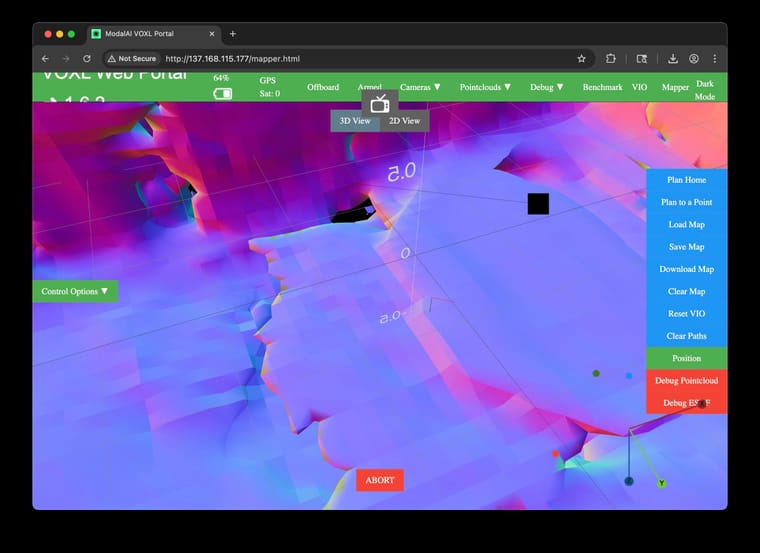
Hello @Cliff-Wong,
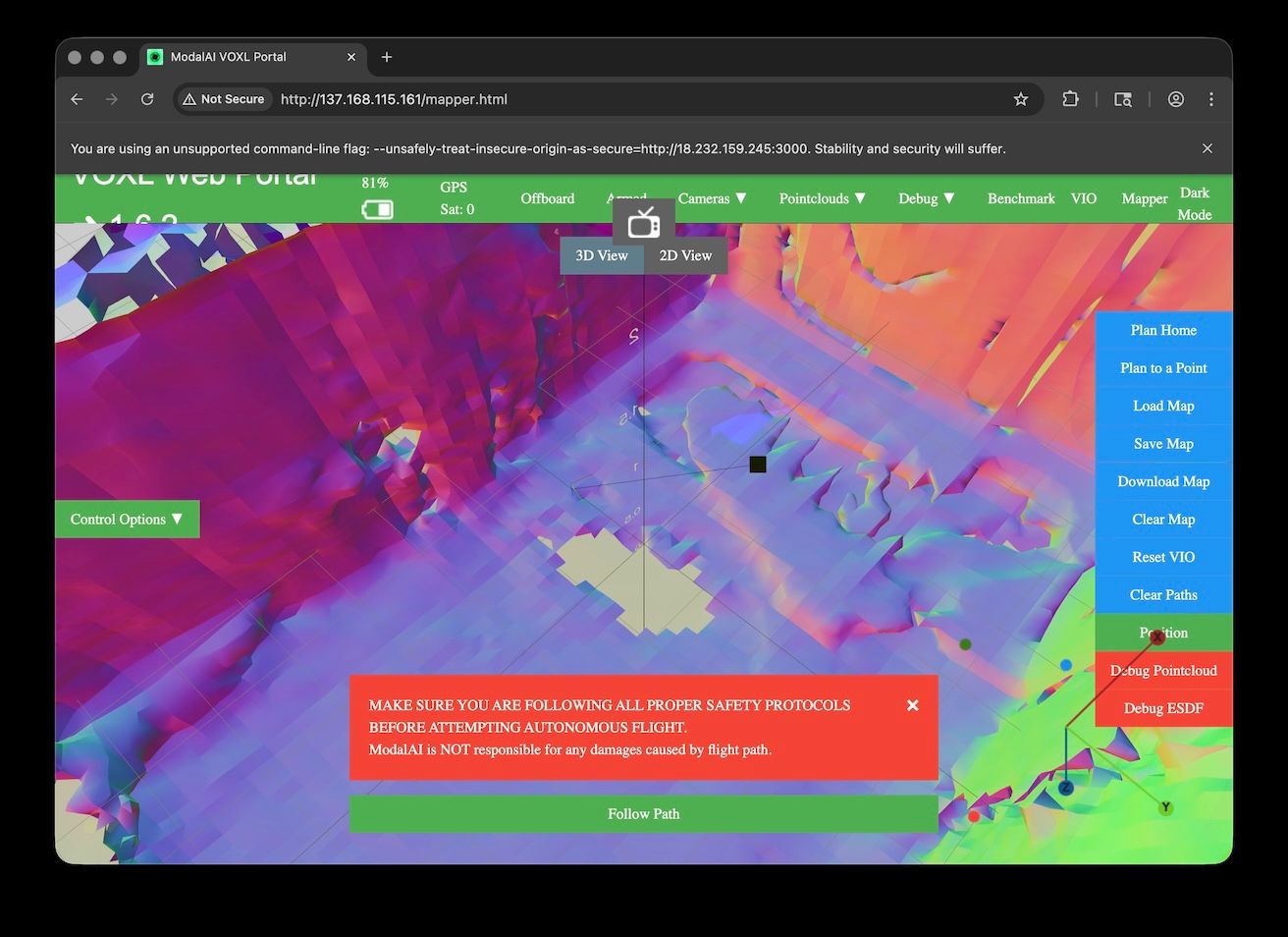
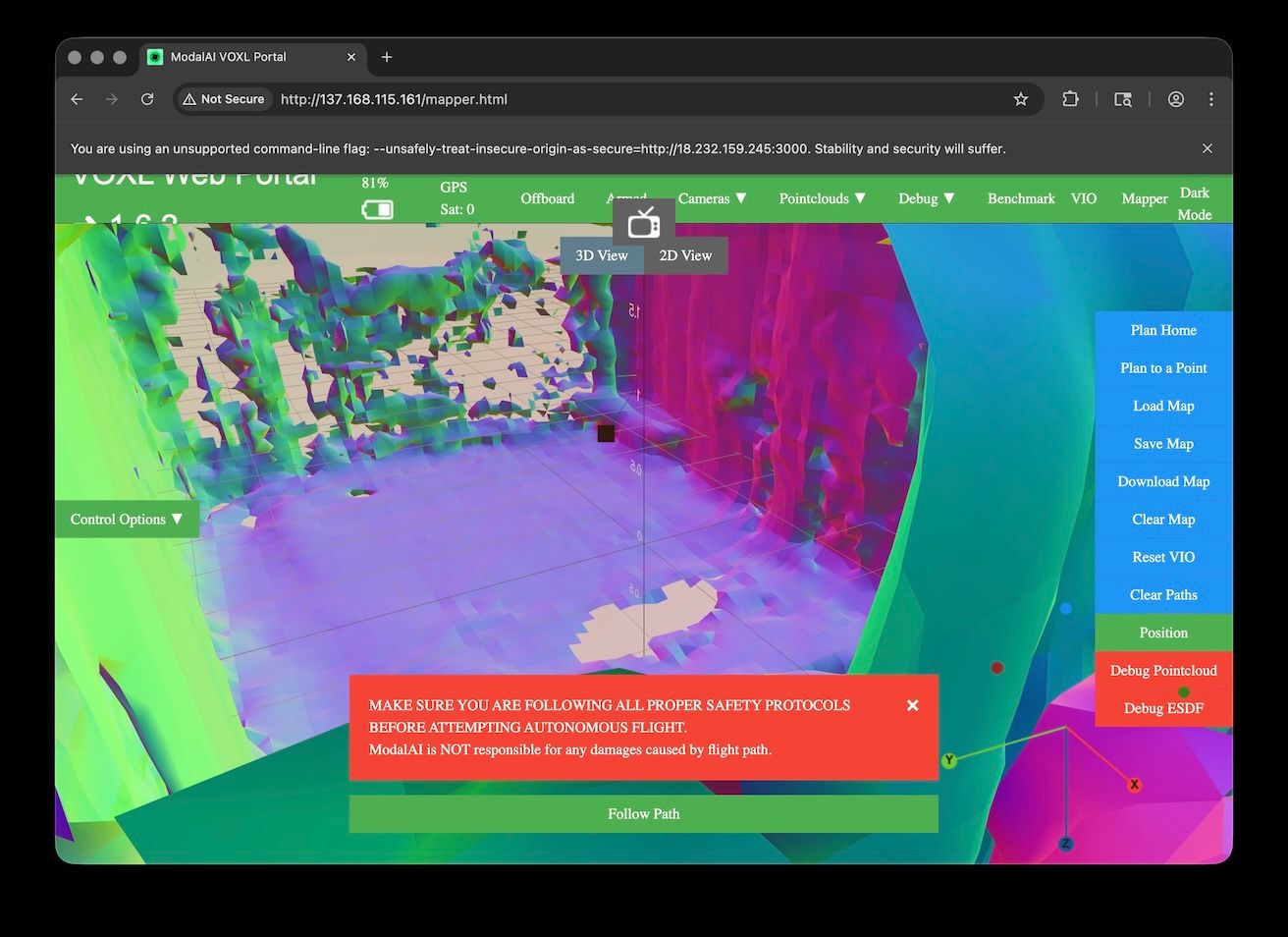
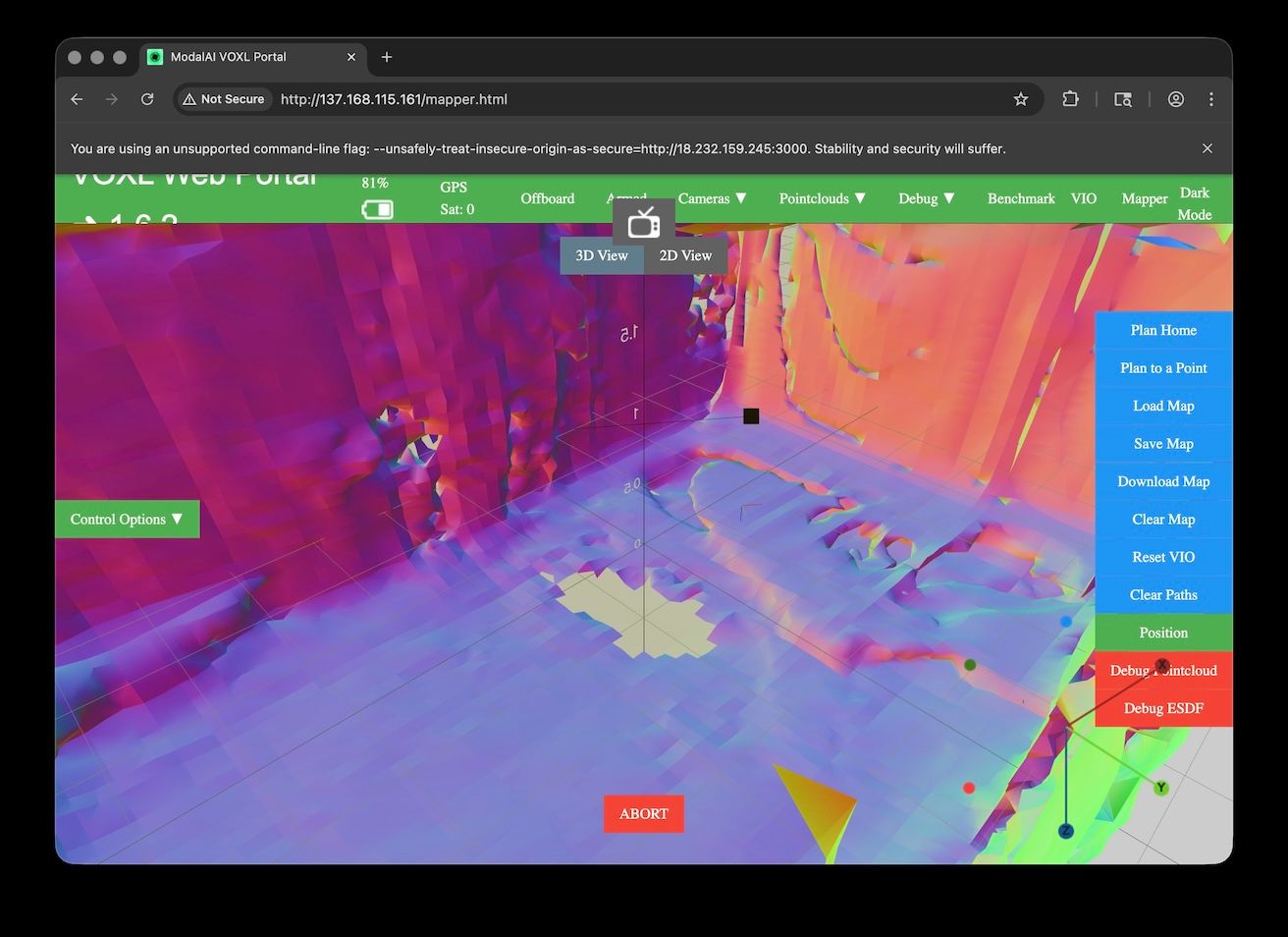
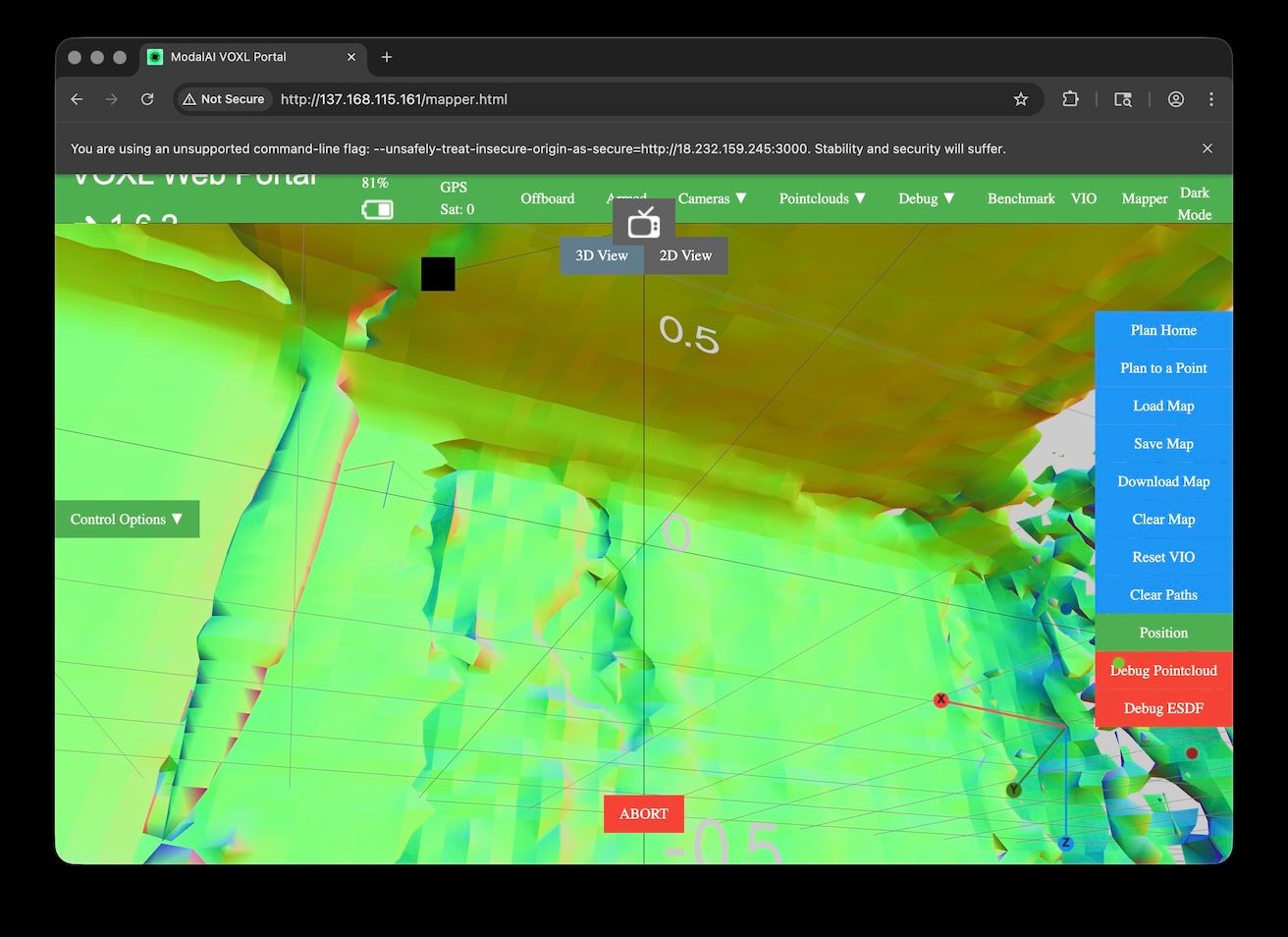
Yes, I flew the drone around the room in position mode until the map was generated. I then flipped the remote to offboard with 'trajectory' set. Here are the files below:
/**
- VOXL Vision PX4 Configuration File
- version: don't touch this, used to keep track of changing config file formats
- ##############################################################################
-
MAVROS MAVSDK
- ##############################################################################
- en_localhost_mavlink_udp:
-
If you are running MAVROS/MAVSDK onboard VOXL and wish to open access to
-
PX4 through a localhost UDP port simply ensure the follow feature is
-
enabled. This is set to true by default. This will allow one local process
-
to communicate with PX4 via port 14551 by default, NOT 14550 which is
-
reserved for connections outside the board. These separation prevents
-
conflicts between the two sockets. Both MAVROS and MAVSDK can be
-
configured to use this port.
- localhost_udp_port_number:
-
Port number for localhost UDP socket, default 14551
- ##############################################################################
-
VIO
- ##############################################################################
- en_vio:
-
Enable processing of VIO data from MPA to be sent to PX4 as mavlink
-
odometry messages. Enabled by default.
- vio_pipe:
-
Primary pipe to subscribe to for VIO data. Must be a standard libmodal-pipe
-
vio_data_t type. Default is qvio. If no data is available on this pipe
-
then voxl-vision-hub will subscribe to secondary_vio_pipe instead.
- secondary_vio_pipe:
-
Secondary pipe to subscribe to for VIO data. Must be a standard libmodal-pipe
-
vio_data_t type. Default is ov for openvins. If no data is available on this
-
pipe then voxl-vision-hub will subscribe to the primary vio_pipe instead.
-
Set to an empty string to disable. Default: ov
- en_reset_vio_if_initialized_inverted:
-
For VIO algorithms like qVIO that can initialize in any orientation
-
and output their estimate of the gravity vector, we suggest leaving
-
this enabled to allow vvpx4 to automatically send the reset signal
-
back to the VIO pipe if VIO was initialized upside-down or sufficiently
-
off-level. Helpful if the user powers on a drone while carrying it to
-
the flight area and VIO starts too early.
- vio_warmup_s:
-
Wait this for this amount of time of having good VIO data before
-
actually starting to send to PX4. This helps stop EKF2 getting
-
confused if VIO flickers in and out while struggling to init.
-
Set to 0 to disable the feature.
- send_odom_while_failed:
-
On by default. Send Odometry messages to PX4 with a quality of -1 when
-
VIO indicates a failure so EKF2 can start dead reckoning.
-
This MAY need to be turned off with PX4 versions older than 1.14
-
since the quality metric was no implemented prior to PX4 1.14
- ##############################################################################
-
APQ8096-only Features
- ##############################################################################
- en_set_clock_from_gps:
-
Enable setting the VOXL system time to GPS time if no NTP server can be
-
reached via network to set the time.
- en_force_onboard_mav1_mode:
-
Force PX4 to use onboard mode for mavlink 1 channel which is the channel
-
apq8096 (VOXL1) uses to communicate UART Mavlink with PX4. Not applicable
-
to qrb5165-based platforms. Sets the MAV1_MODE PX4 param.
- en_reset_px4_on_error:
-
Trigger a reboot of PX4 one some of PX4's unrecoverable errors,
-
Not applicable to qrb5165
-
Yaw estimate error & High Accelerometer Bias and both detected
- ##############################################################################
-
Misc Features
- ##############################################################################
- horizon_cal_tolerance:
-
Allowable standard deviation in roll/pitch values to consider the drone
-
stable enough in flight to do a PX4 horizon calibration. Default is 0.45,
-
you can increase this slightly if flying in a small indoor area or with
-
a drone that does not hold still very well.
-
See https://docs.modalai.com/calibrate-px4-horizon/
- en_hitl:
-
Enable Hardware In The Loop (HITL) testing extensions. Disabled by default.
- ##############################################################################
-
offboard mode config
- ##############################################################################
- offboard_mode: The following are valid strings
-
off: VVPX4 will not send any offboard commands to PX4
-
figure_eight: Default value, VVPX4 commands PX4 to fly a figure 8 path
-
follow_tag: Drone will follow an apriltag around. Very dangerous, not
-
recommended for customer use, for ModalAI R&D only.
-
trajectory: VVPX4 receives polynomial trajectories by pipe and commands
-
PX4 to follow the trajectory path. Still in development.
-
backtrack: Drone will replay, in reverse order, the last few seconds of it's
-
position including yaw. This is useful when the drone loses
-
the communication link and needs to get back to a place where
-
it is able to regain the link. This mode will notice when the
-
RC link goes away and sends a command to px4 to enter offboard mode.
-
wps: read waypoints in local coordinate system
- follow_tag_id:
-
Apriltag ID to follow in follow_tag mode
- figure_eight_move_home:
-
Enable by default, resets the center of the figure 8 path to wherever
-
the drone is when flipped into offboard mode. When disabled, the drone
-
will quickly fly back to the XYZ point 0,0,-1.5 in VIO frame before
-
starting the figure 8. Disabling this feature can be dangerous if VIO
-
has drifted significantly.
- wps_move_home:
-
Enable by default, resets the center of the wps path to wherever
-
the drone is when flipped into offboard mode. When disabled, the drone
-
will quickly fly back to the XYZ point 0,0,-1.5 in VIO frame before
-
starting the figure 8. Disabling this feature can be dangerous if VIO
-
has drifted significantly.
- robot_radius:
-
Robot radius to use when checking collisions within the trajectory monitor.
-
The trajectory monitor is only active when in trajectory mode
- collision_sampling_dt:
-
The time step to sample along the polynomials by when checking for collisions
-
in the collision monitor.
- max_lookahead_distance:
-
Maximum distance to look along the trajectory. Sensor data further out can be
-
unrealiable so keeping this value small reduces false positives
- backtrack_seconds:
-
Number of seconds worth of position data to store for replay in backtrack mode.
- backtrack_rc_chan:
-
RC channel to monitor for transitions into and out of backtrack mode.
- backtrack_rc_thresh:
-
Value above which backtrack is considered enabled on the configured RC channel.
- ##############################################################################
-
Fixed Frame Tag Relocalization
- ##############################################################################
- en_tag_fixed_frame:
-
Enable fixed frame relocalization via voa_inputs.
-
See: https://docs.modalai.com/voxl-vision-px4-apriltag-relocalization/
- fixed_frame_filter_len:
-
Length of the moving average filter to use for smooth relocalization
-
when a tag is detected. Default is 5, a longer filter will result in
-
smoother behavior when a new tag comes into view. Set to 1 to do no
-
filtering at all and assume every tag detection is accurate.
- en_transform_mavlink_pos_setpoints_from_fixed_frame:
-
When enabled, mavlink position_target_local_ned_t commands received on
-
via UDP will be assumed to be in fixed frame and are then transformed
-
to local frame before being sent to PX4. This allows offboard mode
-
position commands from MAVROS/MAVSDK to be in fixed frame relative to
-
voa_inputs even though PX4/EKF2 operates in local frame relative to where
-
VIO initialized.
- ##############################################################################
-
Collision Prevention (VOA)
-
Settings for configuring Mavlink data sent to Autopilot for VOA
- ##############################################################################
- en_voa:
-
Enable processing of DFS and TOF data to be sent to PX4 as mavlink
-
obstacle_distance messages for collision prevention in position mode.
- voa_lower_bound_m & voa_upper_bound_m:
-
VOA ignores obstacles above and below the upper and lower bounds.
-
Remember, Z points downwards in body and NED frames, so the lower bound
-
is a positive number, and the upper bound is a negative number.
-
Defaults are lower: 0.15 upper: -0.15 Units are in meters.
- voa_memory_s:
-
number of seconds to keep track of sensor readings for VOA
-
default: 1.0
- voa_max_pc_per_fusion:
-
maximum number of sensor samples (points clouds) to fuse for every
-
mavlink transmision. Default is 100 so that voa_memory_s determines
-
when to discard old data instead. set this to 1 if you only want to use
-
the most recent sensor sample for example. If you start severly limiting
-
the number of point clouds used per fusion, you will also need to lower
-
voa_pie_threshold.
- voa_pie_min_dist_m:
-
minimum distance from the drone's center of mass to consider a sensor
-
sample a valid point for mavlink transmission.
- voa_pie_max_dist_m:
-
minimum distance from the drone's center of mass to consider a sensor
-
sample a valid point for mavlink transmission. Note this is and can be
-
different from the individual sensor limits.
- voa_pie_under_trim_m:
-
VOA discards points in a bubble under the drone with this radius.
-
default 1.0. This helps the drone approach an obstacle, stop
-
ascend, and continue forward smoothly over the top.
- voa_pie_threshold:
-
Minimum number of points that must appear in and adjacent to a pie
-
segment to consider it populated. Default 3
- voa_send_rate_hz:
-
Rate to send VOA mavlink data to autopilot. Independent from the
-
sensor input rates. Default 20
- voa_pie_slices:
-
number of slices to divide the 360 degree span around the drone into.
-
default 36 (10 degree slices)
- voa_pie_bin_depth_m:
-
Radial depth of each bin during the pie binning step. Default 0.15
- ##############################################################################
-
Collision Prevention (VOA) Input Configuration
-
Settings for configuring pipe data sources for VOA
- ##############################################################################
- voa_inputs:
-
Array of pipes to subscribe to for use with VOA, up to 10 supported
-
Each entry has 4 fields:
- Fields:
- enabled: true or false, it's safe to leave this enabled when the pipe is missing
- type: can be point_cloud, tof, or rangefinder
- input_pipe: pipe name, e.g. stereo_front_pc, rangefinders, tof, etc
- frame: frame of reference, should be listed in /etc/modalai/extrinsics/conf
- max_depth: trim away points with z greater than this
- min_depth: trim away points with z less than this
- cell_size: size of 3d voxel grid cells, increase for more downsampling
- threshold: num points that must exist in or adjacent to a cell to consider it
-
populated, set to 1 to disable threasholding
- x_fov_deg: FOV of the sensor in the x direction, typically width
- y_fov_deg: FOV of the sensor in the y direction, typically height
- conf_cutoff: discard points below this confidence, only applicable to TOF
*/
{
"config_file_version": 1,
"en_localhost_mavlink_udp": false,
"localhost_udp_port_number": 14551,
"en_vio": true,
"vio_pipe": "qvio",
"secondary_vio_pipe": "ov",
"vfc_vio_pipe": "ov",
"en_reset_vio_if_initialized_inverted": true,
"vio_warmup_s": 3,
"send_odom_while_failed": true,
"horizon_cal_tolerance": 0.5,
"en_hitl": false,
"offboard_mode": "trajectory",
"follow_tag_id": 0,
"figure_eight_move_home": true,
"robot_radius": 0.300000011920929,
"collision_sampling_dt": 0.1,
"max_lookahead_distance": 1,
"backtrack_seconds": 60,
"backtrack_rc_chan": 8,
"backtrack_rc_thresh": 1500,
"wps_move_home": true,
"wps_stride": 0,
"wps_timeout": 0,
"wps_damp": 1,
"wps_vfc_mission": true,
"wps_vfc_mission_loop": false,
"wps_vfc_mission_to_ramp": 25,
"wps_vfc_mission_to_kp": 0.10000000149011612,
"wps_vfc_mission_cruise_speed": 1,
"en_tag_fixed_frame": false,
"fixed_frame_filter_len": 5,
"en_transform_mavlink_pos_setpoints_from_fixed_frame": false,
"vfc_rate": 100,
"vfc_rc_chan_min": 980,
"vfc_rc_chan_max": 2020,
"vfc_thrust_ch": 3,
"vfc_roll_ch": 1,
"vfc_pitch_ch": 2,
"vfc_yaw_ch": 4,
"vfc_submode_ch": 6,
"vfc_alt_mode_rc_min": 0,
"vfc_alt_mode_rc_max": 0,
"vfc_flow_mode_rc_min": 0,
"vfc_flow_mode_rc_max": 0,
"vfc_hybrid_flow_mode_rc_min": 0,
"vfc_hybrid_flow_mode_rc_max": 0,
"vfc_position_mode_rc_min": 0,
"vfc_position_mode_rc_max": 2100,
"vfc_traj_mode_rc_min": 0,
"vfc_traj_mode_rc_max": 0,
"vfc_yaw_deadband": 30,
"vfc_vxy_deadband": 50,
"vfc_vz_deadband": 150,
"vfc_min_thrust": 0,
"vfc_max_thrust": 0.800000011920929,
"vfc_tilt_max": 0.43599998950958252,
"vfc_yaw_rate_max": 3,
"vfc_thrust_hover": 0.5,
"vfc_vz_max": 1,
"vfc_kp_z": 5.2899999618530273,
"vfc_kd_z": 5.9800000190734863,
"vfc_vxy_max": 3,
"vfc_kp_xy": 0.63999998569488525,
"vfc_kd_xy": 2.559999942779541,
"vfc_kp_z_vio": 5.2899999618530273,
"vfc_kd_z_vio": 5.9800000190734863,
"vfc_kp_xy_vio": 3.2400000095367432,
"vfc_kd_xy_vio": 3.9600000381469727,
"vfc_w_filt_xy_vio": 10,
"vfc_w_filt_xy_flow": 3,
"vfc_vel_ff_factor_vio": 0.899999976158142,
"vfc_xy_acc_limit_vio": 2.5,
"vfc_max_z_delta": 3,
"vfc_att_transition_time": 0.5,
"vfc_stick_move_threshold": 30,
"vfc_flow_transition_time": 1,
"vfc_q_min": 10,
"vfc_points_min": 7,
"vfc_en_submode_announcement": 1,
"vfc_disable_fallback": false,
"vfc_traj_csv": "/data/voxl-vision-hub/traj.csv",
"en_voa": true,
"voa_upper_bound_m": -0.15000000596046448,
"voa_lower_bound_m": 0.15000000596046448,
"voa_voa_memory_s": 1,
"voa_max_pc_per_fusion": 100,
"voa_pie_max_dist_m": 20,
"voa_pie_min_dist_m": 0.25,
"voa_pie_under_trim_m": 1,
"voa_pie_threshold": 3,
"voa_send_rate_hz": 20,
"voa_pie_slices": 36,
"voa_pie_bin_depth_m": 0.15000000596046448,
"voa_inputs": [{
"enabled": true,
"type": "point_cloud",
"input_pipe": "dfs_point_cloud",
"frame": "stereo_l",
"max_depth": 8,
"min_depth": 0.300000011920929,
"cell_size": 0.079999998211860657,
"threshold": 4,
"x_fov_deg": 68,
"y_fov_deg": 56,
"conf_cutoff": 0
}, {
"enabled": true,
"type": "point_cloud",
"input_pipe": "stereo_front_pc",
"frame": "stereo_front_l",
"max_depth": 8,
"min_depth": 0.300000011920929,
"cell_size": 0.079999998211860657,
"threshold": 4,
"x_fov_deg": 68,
"y_fov_deg": 56,
"conf_cutoff": 0
}, {
"enabled": true,
"type": "point_cloud",
"input_pipe": "stereo_rear_pc",
"frame": "stereo_rear_l",
"max_depth": 8,
"min_depth": 0.300000011920929,
"cell_size": 0.079999998211860657,
"threshold": 4,
"x_fov_deg": 68,
"y_fov_deg": 56,
"conf_cutoff": 0
}, {
"enabled": true,
"type": "tof",
"input_pipe": "tof",
"frame": "tof",
"max_depth": 6,
"min_depth": 0.15000000596046448,
"cell_size": 0.079999998211860657,
"threshold": 3,
"x_fov_deg": 106.5,
"y_fov_deg": 85.0999984741211,
"conf_cutoff": 125
}, {
"enabled": true,
"type": "rangefinder",
"input_pipe": "rangefinders",
"frame": "body",
"max_depth": 8,
"min_depth": 0.300000011920929,
"cell_size": 0.079999998211860657,
"threshold": 4,
"x_fov_deg": 68,
"y_fov_deg": 56,
"conf_cutoff": 0
}]
}
/**
-
This file contains configuration that's specific to voxl-open-vins-server.
-
NOTE: all time variables are measured in seconds
-
OpenVins param breakdown:
-
do_fej: whether or not to do first estimate Jacobians
-
imu_avg: whether or not use imu message averaging
-
use_rk4_integration: if we should use Rk4 imu integration.
-
cam_to_imu_refinement: whether or not to refine the imu-to-camera pose
-
cam_intrins_refinement: whether or not to refine camera intrinsics
-
cam_imu_ts_refinement: whether or not to calibrate cam to IMU time offset
-
max_clone_size: max clone size of sliding window
-
max_slam_features: max number of estimated SLAM features
-
max_slam_in_update: max number of SLAM features in a single EKF update
-
max_msckf_in_update: max number of MSCKF features used at an image timestep
-
Feature Reps can be any of the following:
-
0 - GLOBAL_3D
-
1 - GLOBAL_FULL_INVERSE_DEPTH
-
2 - ANCHORED_3D
-
3 - ANCHORED_FULL_INVERSE_DEPTH
-
4 - ANCHORED_MSCKF_INVERSE_DEPTH
-
5 - ANCHORED_INVERSE_DEPTH_SINGLE
-
feat_rep_msckf: (int) what representation our msckf features are in
-
feat_rep_slam: (int) what representation our slam features are in
-
cam_imu_time_offset: time offset between camera and IMU
-
slam_delay: delay that we should wait from init before estimating SLAM features
-
gravity_mag: gravity magnitude in the global frame
-
init_window_time: amount of time to initialize over
-
init_imu_thresh: variance threshold on our accel to be classified as moving
-
imu_sigma_w: gyroscope white noise (rad/s/sqrt(hz))
-
imu_sigma_wb: gyroscope random walk (rad/s^2/sqrt(hz))
-
imu_sigma_a: accelerometer white noise (m/s^2/sqrt(hz))
-
imu_sigma_ab: accelerometer random walk (m/s^3/sqrt(hz))
-
imu_sigma_w_2: gyroscope white noise covariance
-
imu_sigma_wb_2: gyroscope random walk covariance
-
imu_sigma_a_2: accelerometer white noise covariance
-
imu_sigma_ab_2: accelerometer random walk covariance
-
****_chi2_multiplier: what chi-squared multipler we should apply
-
****_sigma_px: noise sigma for our raw pixel measurements
-
****_sigma_px_sq: covariance for our raw pixel measurements
-
use_stereo: if feed_measurement_camera is called with more than one
-
image, this determines behavior. if true, they are treated as a stereo
-
pair, otherwise treated as binocular system
-
if you enable a camera with stereo in the name, this will be set to true
-
automatically
-
try_zupt: if we should try to use zero velocity update
-
zupt_max_velocity: max velocity we will consider to try to do a zupt
-
zupt_only_at_beginning: if we should only use the zupt at the very beginning
-
zupt_noise_multiplier: multiplier of our zupt measurement IMU noise matrix
-
zupt_max_disparity: max disparity we will consider to try to do a zupt
-
NOTE: set zupt_max_disparity to 0 for only imu based zupt, and
-
zupt_chi2_multipler to 0 for only display based zupt
-
num_pts: number of points we should extract and track in each image frame
-
fast_threshold: fast extraction threshold
-
grid_x: number of column-wise grids to do feature extraction in
-
grid_y: number of row-wise grids to do feature extraction in
-
min_px_dist: after doing KLT track will remove any features closer than this
-
knn_ratio: KNN ration between top two descriptor matchers for good match
-
downsample_cams: will half image resolution
-
use_nultithreading: if we should use multi-threading for stereo matching
-
use_mask: if we should load a mask and use it to reject invalid features
*/
{
"en_auto_reset": true,
"auto_reset_max_velocity": 20,
"auto_reset_max_v_cov_instant": 0.10000000149011612,
"auto_reset_max_v_cov": 0.10000000149011612,
"auto_reset_max_v_cov_timeout_s": 0.5,
"auto_reset_min_features": 1,
"auto_reset_min_feature_timeout_s": 3,
"auto_fallback_timeout_s": 3,
"auto_fallback_min_v": 0.600000023841858,
"en_cont_yaw_checks": false,
"fast_yaw_thresh": 5,
"fast_yaw_timeout_s": 1.75,
"do_fej": true,
"imu_avg": true,
"use_rk4_integration": true,
"cam_to_imu_refinement": true,
"cam_intrins_refinement": true,
"cam_imu_ts_refinement": true,
"max_clone_size": 8,
"max_slam_features": 35,
"max_slam_in_update": 10,
"max_msckf_in_update": 10,
"feat_rep_msckf": 4,
"feat_rep_slam": 4,
"cam_imu_time_offset": 0,
"slam_delay": 1,
"gravity_mag": 9.80665,
"init_window_time": 1,
"init_imu_thresh": 1,
"imu_sigma_w": 0.00013990944749616306,
"imu_sigma_wb": 4.1189724174615527e-07,
"imu_sigma_a": 0.0038947538150776763,
"imu_sigma_ab": 5.538346201712153e-05,
"msckf_chi2_multiplier": 1,
"slam_chi2_multiplier": 40,
"zupt_chi2_multiplier": 1,
"refine_features": true,
"pyr_levels": 6,
"grid_x": 5,
"grid_y": 5,
"msckf_sigma_px": 1,
"slam_sigma_px": 1.8,
"zupt_sigma_px": 1,
"try_zupt": true,
"zupt_max_velocity": 0.03,
"zupt_only_at_beginning": true,
"zupt_noise_multiplier": 1,
"zupt_max_disparity": 8,
"init_dyn_use": false,
"triangulate_1d": false,
"max_runs": 5,
"init_lamda": 0.001,
"max_lamda": 10000000000,
"min_dx": 1e-06,
"min_dcost": 1e-06,
"lam_mult": 10,
"min_dist": 0.1,
"max_dist": 60,
"max_baseline": 40,
"max_cond_number": 600000,
"use_mask": false,
"use_stereo": false,
"use_baro": false,
"num_opencv_threads": 4,
"fast_threshold": 15,
"histogram_method": 1,
"knn_ratio": 0.7,
"takeoff_accel_threshold": 0.5,
"takeoff_threshold": -0.1,
"use_stats": false,
"max_allowable_cep": 1,
"en_force_init": false,
"en_force_ned_2_flu": false,
"en_imu_frame_output": false,
"track_frequency": 15,
"publish_frequency": 5,
"en_vio_always_on": true,
"en_ext_feature_tracker": false,
"en_gpu_for_tracking": true,
"num_features_to_track": 20,
"raansac_gn": false,
"raansac_tri": true,
"en_thermal_enhance": false,
"en_overlay_landscape": false,
"thermal_brightness": 1,
"thermal_brightness_bos": 1
}