
mating cycle query
-
Hey @Alex-Kushleyev @Vinny @Eric-Katzfey ,
I had query regarding the mating cycles of the components.
Does Voxl2 and M0173 board have mating cycle limit?
Also how much is the mating cycle of the camera cables for hire, tracking and TOF?
Is there any mating cycles for flight core v2 connectors?I would really appreciate a clarity on this
With regards -
Hey @Alex-Kushleyev @Vinny @Eric-Katzfey ,
I had query regarding the mating cycles of the components.
Does Voxl2 and M0173 board have mating cycle limit?
Also how much is the mating cycle of the camera cables for hire, tracking and TOF?
Is there any mating cycles for flight core v2 connectors?I would really appreciate a clarity on this
With regardsHi @Jetson-Nano
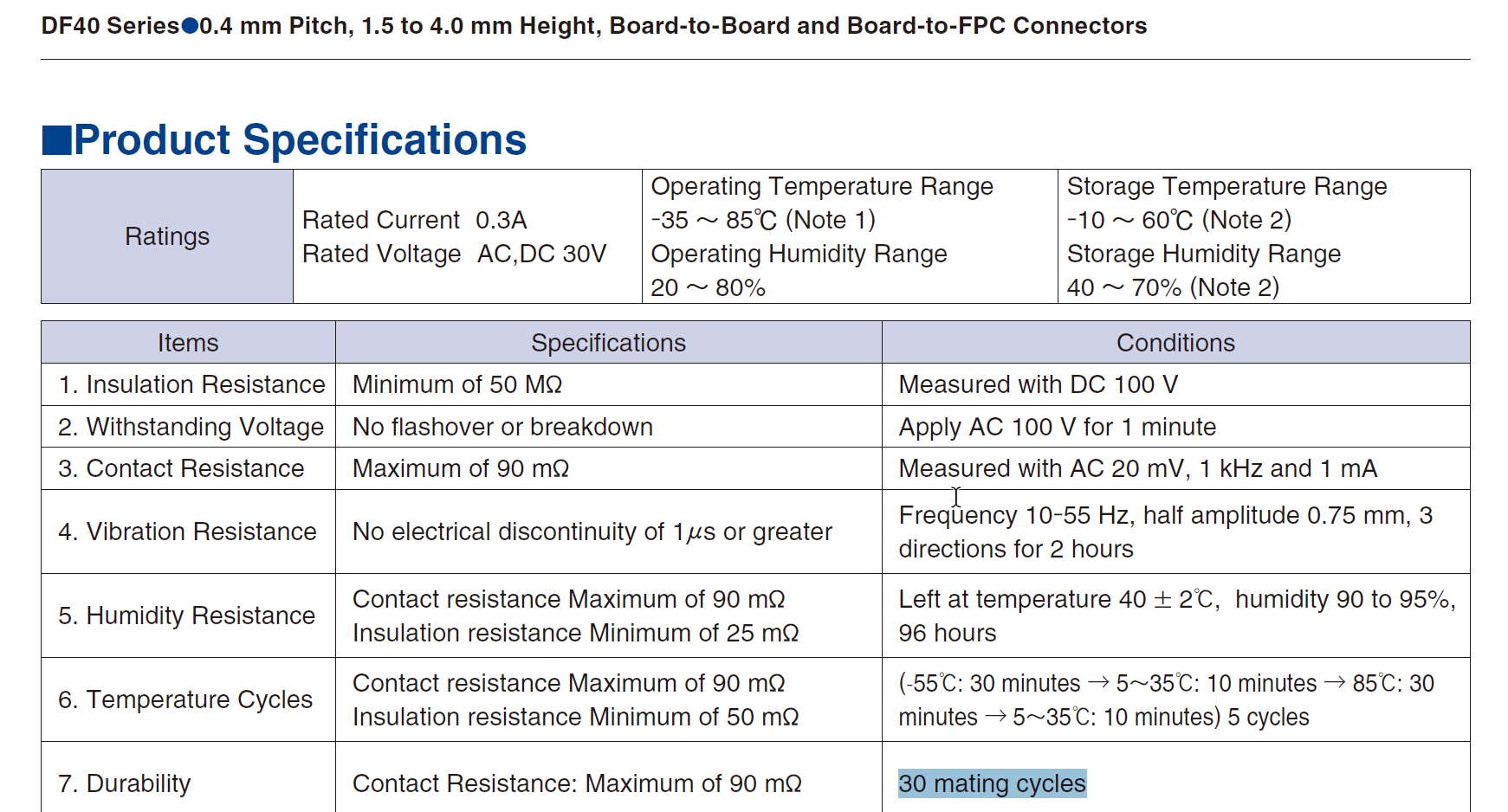
The connectors between VOXL 2 and M0173 are DF40's. They are rated for 30 cycles:
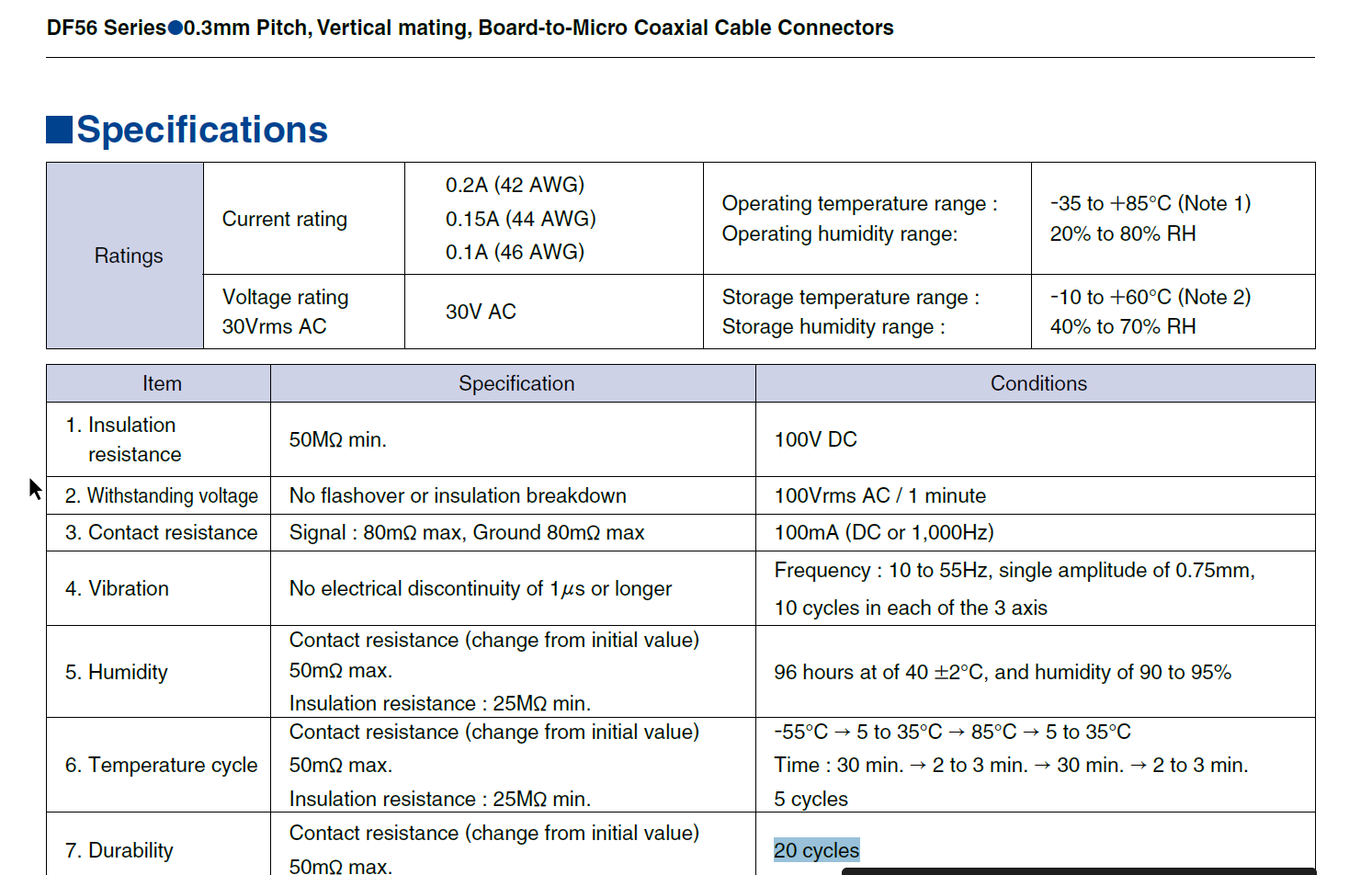
The uCoax image sensor cables are also from Hirose, and are much more fragile. They are rated for 20 cycles, but to be honest, I break them after 3-5 cycles personally if I am not using a tool. With the use of the proper tool we specify here, you should get to 10-20 cycles.
https://docs.modalai.com/micro-coax-user-guide/
FCv2 uses a bunch of JST GH connectors. On the flip side, I've never broken one of those!

JST sadly does not specify the cycle count. So, any number we provide would be a guess. We use it due to DroneCode compliance intentions. They are pretty robust and never experienced any issues.Hope this helps.
-
Hi @Jetson-Nano
The connectors between VOXL 2 and M0173 are DF40's. They are rated for 30 cycles:
The uCoax image sensor cables are also from Hirose, and are much more fragile. They are rated for 20 cycles, but to be honest, I break them after 3-5 cycles personally if I am not using a tool. With the use of the proper tool we specify here, you should get to 10-20 cycles.
https://docs.modalai.com/micro-coax-user-guide/
FCv2 uses a bunch of JST GH connectors. On the flip side, I've never broken one of those!
JST sadly does not specify the cycle count. So, any number we provide would be a guess. We use it due to DroneCode compliance intentions. They are pretty robust and never experienced any issues.Hope this helps.
This post is deleted! -
Hi @Jetson-Nano
The connectors between VOXL 2 and M0173 are DF40's. They are rated for 30 cycles:
The uCoax image sensor cables are also from Hirose, and are much more fragile. They are rated for 20 cycles, but to be honest, I break them after 3-5 cycles personally if I am not using a tool. With the use of the proper tool we specify here, you should get to 10-20 cycles.
https://docs.modalai.com/micro-coax-user-guide/
FCv2 uses a bunch of JST GH connectors. On the flip side, I've never broken one of those!
JST sadly does not specify the cycle count. So, any number we provide would be a guess. We use it due to DroneCode compliance intentions. They are pretty robust and never experienced any issues.Hope this helps.
@Vinny @Alex-Kushleyev @Eric-Katzfey
Hello ModalAI Team,
I am writing to request information regarding the Mean Time To Failure (MTTF) for several hardware components that we have procured from your team for our ongoing development program.
The components include:
VOXL2
ESC
Flight Controller (V2)
Front-End Board (Camera Interface)
Camera ModulesWe would appreciate it if you could share any available MTTF data, reliability reports, or qualification/test standards associated with these products.
If detailed MTTF values are not readily available, any indicative data such as MTBF estimates, environmental test results, or reliability benchmarks would also be helpful.
Please let us know if any additional information is required from our side to process this request.
Thank you for your continued support.
-
@Vinny @Alex-Kushleyev @Eric-Katzfey
Hello ModalAI Team,
I am writing to request information regarding the Mean Time To Failure (MTTF) for several hardware components that we have procured from your team for our ongoing development program.
The components include:
VOXL2
ESC
Flight Controller (V2)
Front-End Board (Camera Interface)
Camera ModulesWe would appreciate it if you could share any available MTTF data, reliability reports, or qualification/test standards associated with these products.
If detailed MTTF values are not readily available, any indicative data such as MTBF estimates, environmental test results, or reliability benchmarks would also be helpful.
Please let us know if any additional information is required from our side to process this request.
Thank you for your continued support.
Hi @Jetson-Nano
Thank you for your request regarding MTTF and reliability data for the listed hardware components.At this time, we do not publish formal MTTF/MTBF values for these products. The primary reason is that these systems (VOXL2, ESC, Flight Controller V2, Front-End Board, and Camera Modules) are delivered as development platforms intended for user-defined integration, testing, and operation. In the vast majority of use cases, overall system lifetime is dominated by application-specific factors such as mechanical stress, environmental exposure, power integrity, and crash events rather than intrinsic electronic wear-out mechanisms. As a result, standardized MTTF/MTBF metrics are not representative or particularly actionable for these platforms.
That said, the underlying silicon and design heritage for these systems is derived from high-volume mobile and embedded computing applications. These components are built on technologies that are broadly characterized for long operational lifetimes under nominal conditions, consistent with industry expectations for modern semiconductor devices.
Additionally, portions of the broader technology heritage have been evaluated in demanding environments, including public programs associated with NASA JPL (e.g., Mars Helicopter which is our design heritage, and CADRE lunar rover initiatives). However, detailed qualification data and reports from those efforts and other non-public efforts are not available for external distribution.
From a reliability perspective, our hardware is designed and validated using standard industry practices, including:
- Functional validation across operating voltage and temperature ranges
- Environmental and stress testing at the system level (i..e: we and our customers put our drones into very demanding scenarios)
- Design margining consistent with mobile/embedded electronics standards, oftentimes far exceeding industry norm
- Production screening and quality control processes and test screening
For applications requiring higher confidence in operational lifetime, we typically recommend system-level validation under the specific mission profile, including environmental testing (thermal cycling, vibration, shock) and power/load characterization representative of the end use case.
Hope this helps.


Reading along? Create a free ModalAI Forum account to join in.
With an account you can reply, ask your own question, get an email when a ModalAI engineer answers, and mark the reply that solved it. Your place in each thread is saved between visits.
Questions about VOXL, Flight Core, ESCs and ModalAI drones are answered here by the engineers who build them.
Register Login