
Poor GPS Fix
-
@Alex-Kushleyev said in Poor GPS Fix:
I believe your name is already on the list to receive it.
Anyway we can get on that list too? We received our starling 2 max nearly a month ago now and have only recently been able to test it. We're happy with everything but the GPS problem makes this product borderline unacceptable. We just had a meeting where we decided to hold off on ordering 5 more starlings because of this issue!
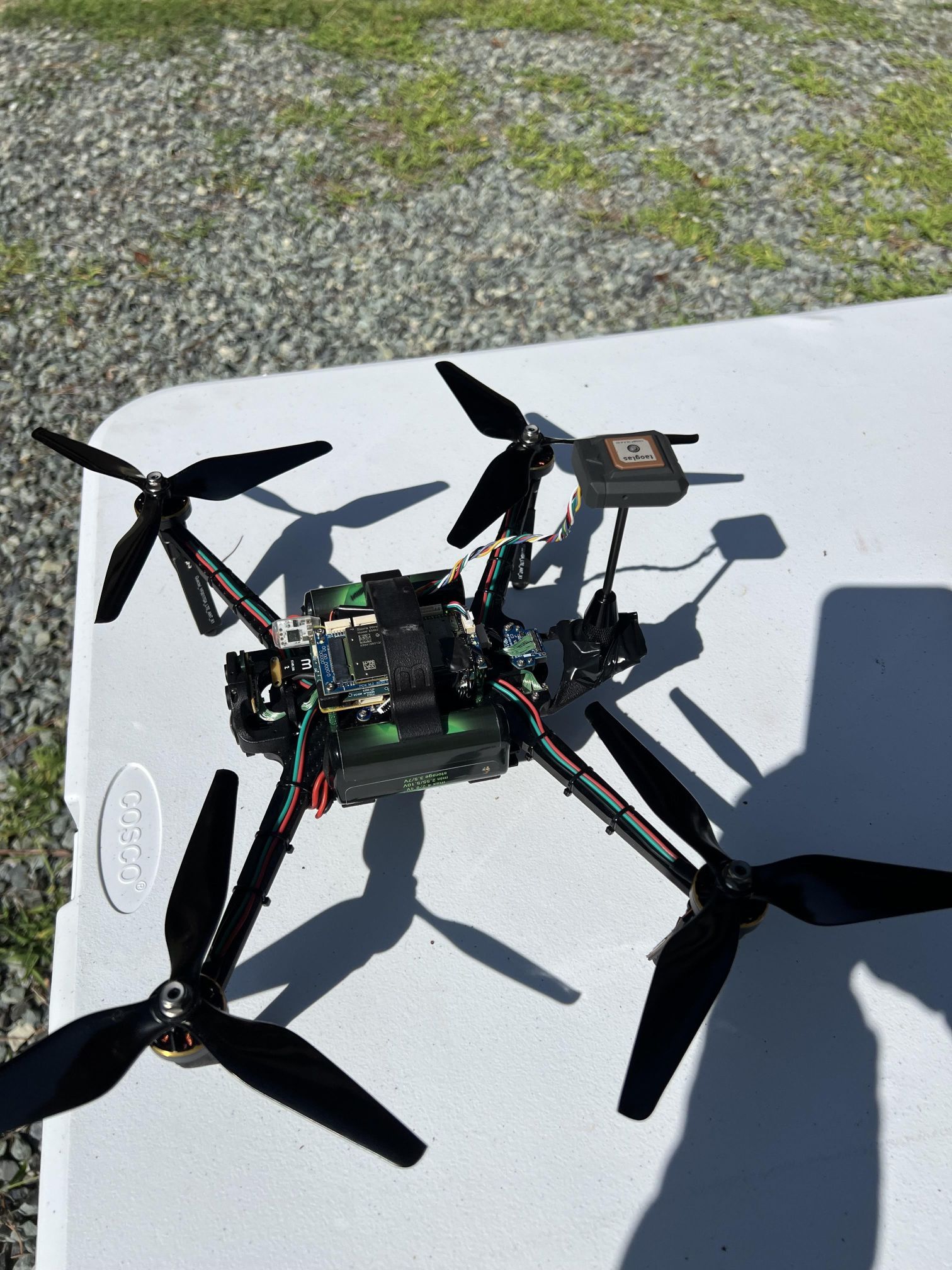
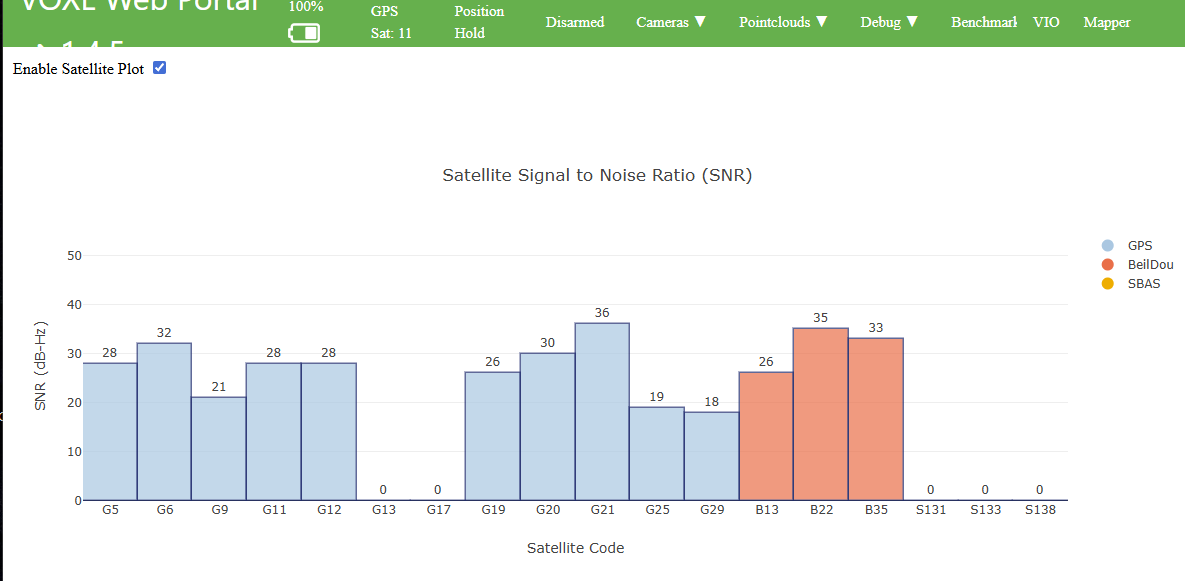
@Rodrigo-Betances @Alex-Kushleyev @somalley OK I received the mast GPS fix from ModalAI and I've installed and tested it. I do get more satellites and the signal is enough to get a GPS lock, so I'm clear to fly at this point. The signal still seems a bit low but maybe that's just my location. I do have a clear view of the sky but there are tall trees not far away that may block satellites below roughly 45 degrees from the horizon.
IMPORTANT: The mast kit shipped with a ca. 10cm 6-pin cable with female JST GH connectors on each end. There is no way to connect that cable to the existing connector, and the cable itself is too short to reach the VOXL2 connector. I would suggest that one end be shipped with a male connector. Otherwise customers will need to make their own cable as I did.
Thanks for your help. Looking forward to reports from others.
-
@Rodrigo-Betances @Alex-Kushleyev @somalley OK I received the mast GPS fix from ModalAI and I've installed and tested it. I do get more satellites and the signal is enough to get a GPS lock, so I'm clear to fly at this point. The signal still seems a bit low but maybe that's just my location. I do have a clear view of the sky but there are tall trees not far away that may block satellites below roughly 45 degrees from the horizon.
IMPORTANT: The mast kit shipped with a ca. 10cm 6-pin cable with female JST GH connectors on each end. There is no way to connect that cable to the existing connector, and the cable itself is too short to reach the VOXL2 connector. I would suggest that one end be shipped with a male connector. Otherwise customers will need to make their own cable as I did.
Thanks for your help. Looking forward to reports from others.
Yes, we are aware about the cable mismatch (sorry, the shipment was rushed a bit, but we will get it right!)
Regarding the satellite SNR, yest it still looks low. I would normally expect 10dB higher.
Are you able to test with disabled 5G modem? maybe pop out the 5G card or shut it down via a pin ( think we discussed how to do this long time ago).
I just received the same kit and will be testing it today and compare with my initial implementation of the mast. Will report back..
Alex
-
@Rodrigo-Betances @Alex-Kushleyev @somalley OK I received the mast GPS fix from ModalAI and I've installed and tested it. I do get more satellites and the signal is enough to get a GPS lock, so I'm clear to fly at this point. The signal still seems a bit low but maybe that's just my location. I do have a clear view of the sky but there are tall trees not far away that may block satellites below roughly 45 degrees from the horizon.
IMPORTANT: The mast kit shipped with a ca. 10cm 6-pin cable with female JST GH connectors on each end. There is no way to connect that cable to the existing connector, and the cable itself is too short to reach the VOXL2 connector. I would suggest that one end be shipped with a male connector. Otherwise customers will need to make their own cable as I did.
Thanks for your help. Looking forward to reports from others.
@ROBERT-JUDD Nice! Hopefully we can get one of those kits too! Green with envy over here haha
-
Yes, we are aware about the cable mismatch (sorry, the shipment was rushed a bit, but we will get it right!)
Regarding the satellite SNR, yest it still looks low. I would normally expect 10dB higher.
Are you able to test with disabled 5G modem? maybe pop out the 5G card or shut it down via a pin ( think we discussed how to do this long time ago).
I just received the same kit and will be testing it today and compare with my initial implementation of the mast. Will report back..
Alex
@Alex-Kushleyev This morning I tried to determine if the 5G service affects the GPS signal. I removed the SIM card, turned off the power using the commands below, and verified that I had no 5G service. I also tried various combinations of these, and I also tried disabling voxl-modem and rebooting.
voxl-gpio -m 1 out
voxl-gpio -w 1 0 # power off
voxl-gpio -w 1 1 # power onNone of these had any effect on the GPS signal. It remains essentially the same as the graph I sent yesterday (20-35 db on ca. 10 satellites). This does get a GPS position lock, however, so probably I can fly.
Looking forward to your results.
-
@Rodrigo-Betances @Alex-Kushleyev @somalley OK I received the mast GPS fix from ModalAI and I've installed and tested it. I do get more satellites and the signal is enough to get a GPS lock, so I'm clear to fly at this point. The signal still seems a bit low but maybe that's just my location. I do have a clear view of the sky but there are tall trees not far away that may block satellites below roughly 45 degrees from the horizon.
IMPORTANT: The mast kit shipped with a ca. 10cm 6-pin cable with female JST GH connectors on each end. There is no way to connect that cable to the existing connector, and the cable itself is too short to reach the VOXL2 connector. I would suggest that one end be shipped with a male connector. Otherwise customers will need to make their own cable as I did.
Thanks for your help. Looking forward to reports from others.
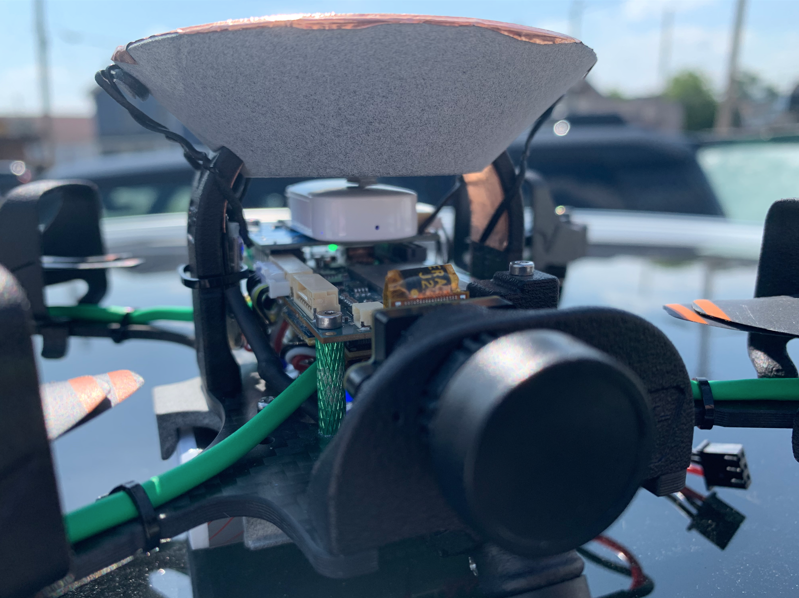
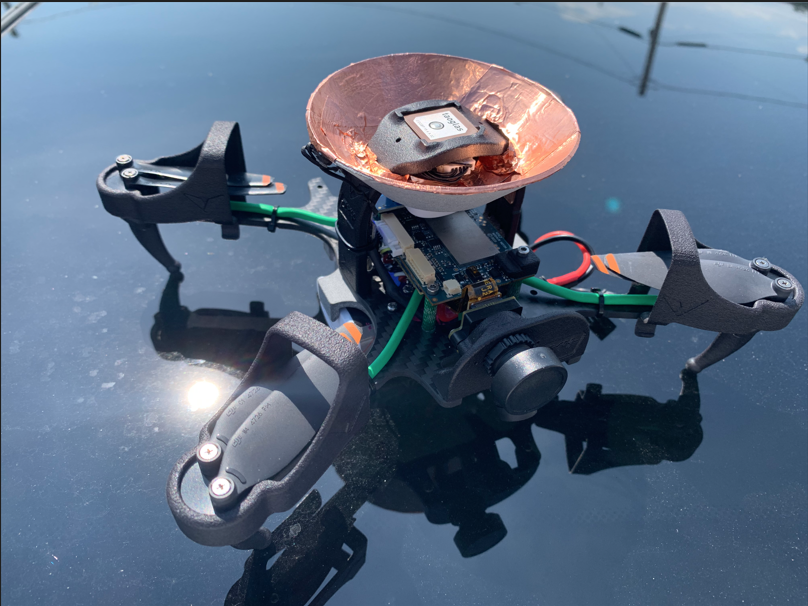
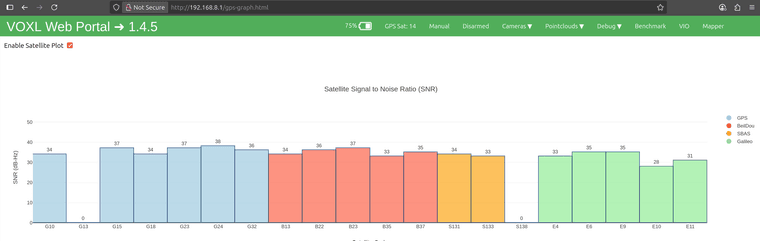
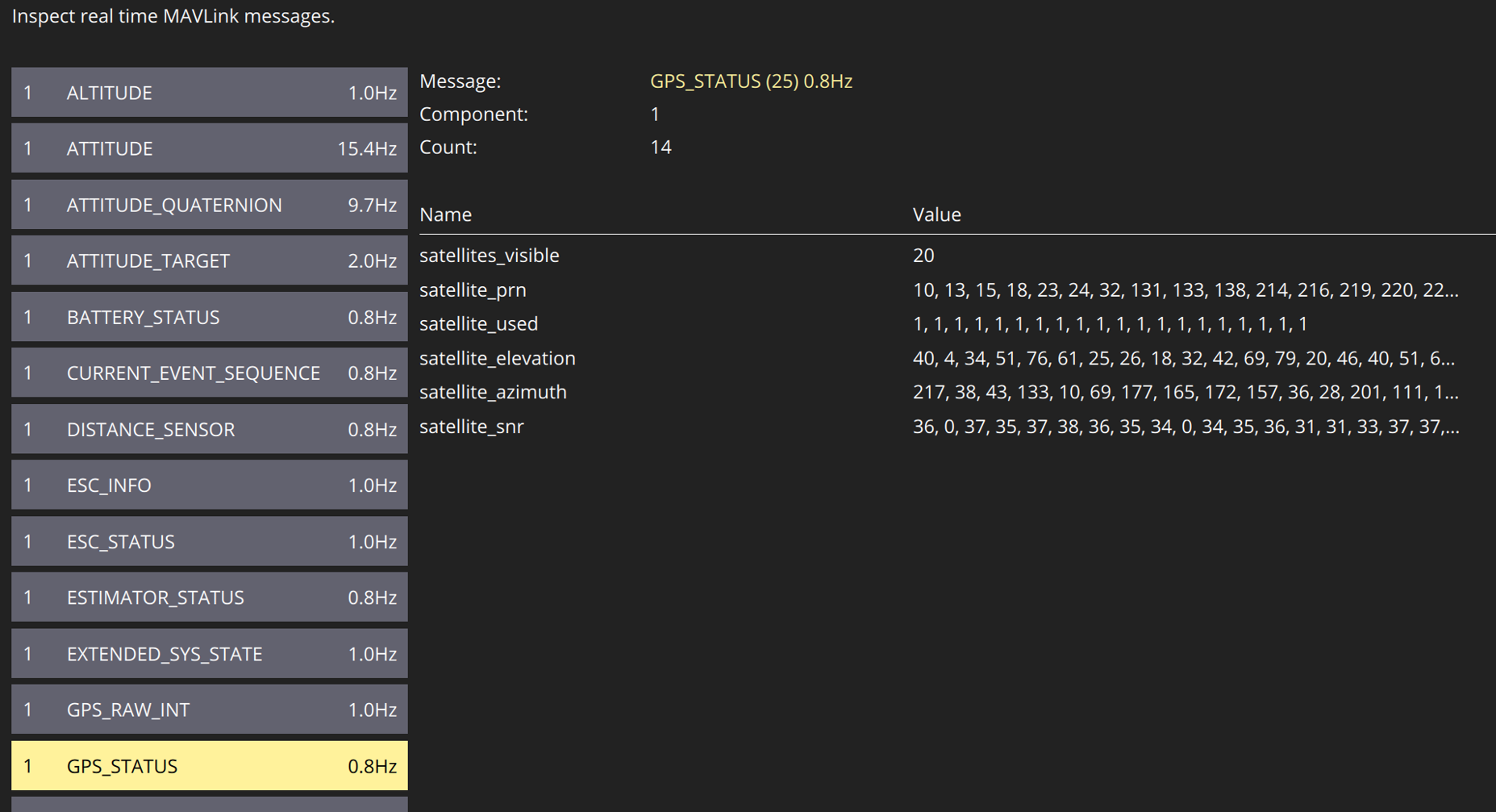
We built upon the shield/cone concept since it showed promise and worked to eliminate any tiny gaps and cracks where EMI could potentially leak through. We designed and 3D printed a cone that would come together on both sides of the GPS antenna mount with enough spacing for them to slide around the posts. The inside of the cone and some of the post had copper tape applied to it. Aim of this is to shield the GPS antenna from all RF below the cone and only receive RF from above. As you can see from the screen captures, the results are very promising. I think my team and I can now move forward in testing that was previously blocked by the poor GPS performance. Hope this helps and inspires some other fixes.
You may want to consider a small RF shield cone on top of your mast.
Here are the results from our custom shield and testing.
-
We built upon the shield/cone concept since it showed promise and worked to eliminate any tiny gaps and cracks where EMI could potentially leak through. We designed and 3D printed a cone that would come together on both sides of the GPS antenna mount with enough spacing for them to slide around the posts. The inside of the cone and some of the post had copper tape applied to it. Aim of this is to shield the GPS antenna from all RF below the cone and only receive RF from above. As you can see from the screen captures, the results are very promising. I think my team and I can now move forward in testing that was previously blocked by the poor GPS performance. Hope this helps and inspires some other fixes.
You may want to consider a small RF shield cone on top of your mast.
Here are the results from our custom shield and testing.
Very cool, thank you for sharing. We will try something like this.
Please note that we have observed that the wifi dongle, which is right under the gps receiver, causes some interference as well. Can you please try to repeat your test by unplugging the dongle completely?
A workaround to move the dongle to a different location is to use a different USB breakout board. Instead of M0141, use M0151 with a cable (JST GH to USB A Female).
Alex
-
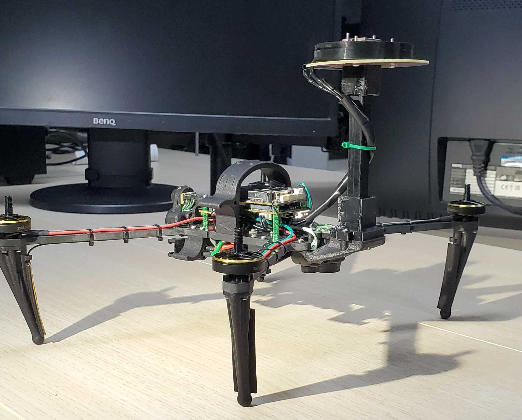
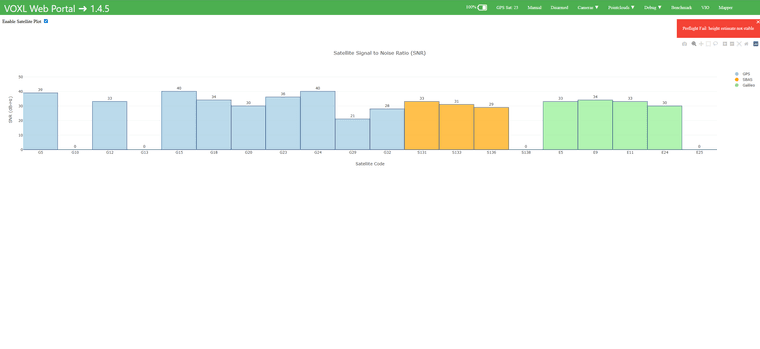
Hey @Alex-Kushleyev how can I get on that mailing list for the ModalAI sanctioned mast? I designed and 3DP two mounts and used a carbon fibre rod, along with a copper laminate board and seen great improvement in GPS count (see image and screenshot).
Did a couple test flights with this set up and everything ran smoothly. I'll have a better peace of mind with an official mast though.Looking forward to your response!
-
Hello everyone,
We’ve been following this discussion with great interest — especially the insights about the mast kit and the copper shielding solution. We also tried similar approaches on our side and wanted to share our results to contribute to the thread.
We purchased four Starling 2 Max drones for our project at the beginning of the year, and like others here, we are experiencing difficulties with GPS stability outdoors. To mitigate interference, we designed and 3D-printed our own GPS mount to move the antenna away from the main body, and we added a copper shielding layer around it.
We then tested the u-blox M10 GPS outside, under clear sky conditions, with the drone powered on (connected via Wi-Fi to use VOXL-Portal). Over about 10 minutes, the best observation we captured showed 18 satellites with an average SNR around 30–35 dB.
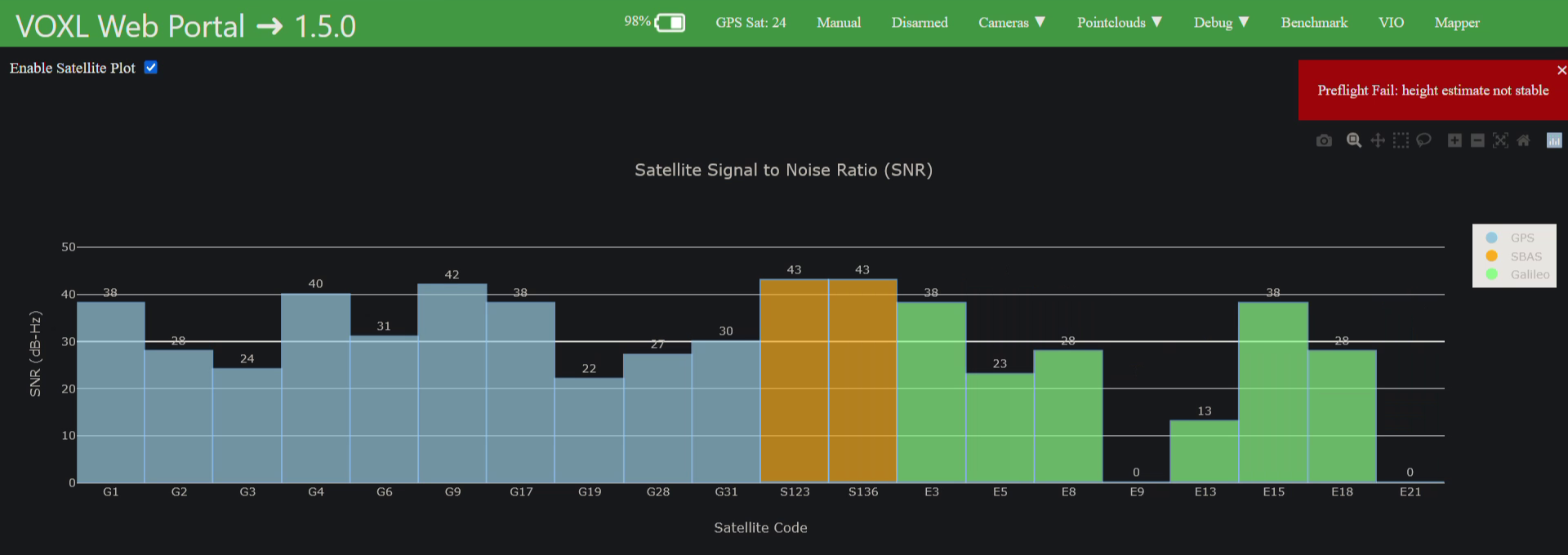
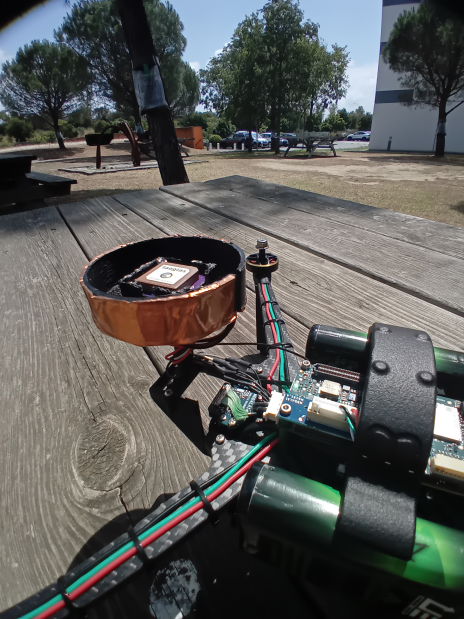
However, despite these results, we still cannot achieve a stable outdoor localization, which currently prevents us from flying the drones properly outside. At this point, we’re unsure whether the problem comes mainly from the GPS performance or possibly from the barometer.
We’d really appreciate:
- Being included in your support list for this GPS issue, since it affects multiple units on our side (as mentioned by @Alex-Kushleyev).
- Any guidance or recommendations on how to debug further (extra shielding, hardware setup, barometer validation, software settings, etc.).
Thanks a lot to the ModalAI team and to the community for the shared ideas — we hope our feedback helps others as well.
Best regards,
Quentin
-
P paulpeshette referenced this topic on
-
Hello everyone,
We’ve been following this discussion with great interest — especially the insights about the mast kit and the copper shielding solution. We also tried similar approaches on our side and wanted to share our results to contribute to the thread.
We purchased four Starling 2 Max drones for our project at the beginning of the year, and like others here, we are experiencing difficulties with GPS stability outdoors. To mitigate interference, we designed and 3D-printed our own GPS mount to move the antenna away from the main body, and we added a copper shielding layer around it.
We then tested the u-blox M10 GPS outside, under clear sky conditions, with the drone powered on (connected via Wi-Fi to use VOXL-Portal). Over about 10 minutes, the best observation we captured showed 18 satellites with an average SNR around 30–35 dB.
However, despite these results, we still cannot achieve a stable outdoor localization, which currently prevents us from flying the drones properly outside. At this point, we’re unsure whether the problem comes mainly from the GPS performance or possibly from the barometer.
We’d really appreciate:
- Being included in your support list for this GPS issue, since it affects multiple units on our side (as mentioned by @Alex-Kushleyev).
- Any guidance or recommendations on how to debug further (extra shielding, hardware setup, barometer validation, software settings, etc.).
Thanks a lot to the ModalAI team and to the community for the shared ideas — we hope our feedback helps others as well.
Best regards,
Quentin
we just posted an update on this topic, please see https://forum.modalai.com/topic/5116/gnss-emi-mitigation-guidelines .
-
For the past two years, I've made a living designing and integrating VOXL2-based systems for clients across Europe. In many cases, I've demonstrated autonomous flight capabilities to customers only to later recommend that they move away from the platform. I've even rebuilt equivalent systems at roughly 30–40% of the cost while delivering many of the same capabilities and, in some cases, a more reliable development experience.
Ironically, a significant portion of my business exists because of the problems I've had to solve within the VOXL2 ecosystem.
If you're considering VOXL2 for research or commercial work, I would strongly encourage you to carefully evaluate the platform before committing to it. Until ModalAI demonstrates a stronger commitment to documentation, software quality, hardware quality control, and customer support, I believe there are better alternatives for most developers.
The following are the most consistent issues I've encountered.
1. Outdated and Incomplete Documentation
Much of the documentation is outdated, incomplete, or simply incorrect. This creates a frustrating development experience where AI language models, developers, and even experienced robotics engineers are all relying on inaccurate information—not because the tools are wrong, but because the official documentation is.
The result is wasted engineering time, unnecessary debugging, and teams losing confidence in otherwise competent engineers who end up chasing problems that originate from incorrect documentation rather than their own mistakes.
2. Quality Control Problems
I've encountered multiple instances of hardware being shipped with incorrect labeling or configuration. The most surprising example was ESC boards intended for 4S batteries being labeled as 6S versions, and vice versa.
Mistakes of this nature should never pass quality control.
What was even more disappointing was the response. Rather than issuing a recall or offering replacements, I was effectively told to live with the problem. I shared that experience with my clients, and it ultimately contributed to the cancellation of an order for ten additional units. Poor customer support doesn't just damage individual relationships—it costs future business.
3. Weak Peripheral Ecosystem
The surrounding hardware ecosystem feels underdeveloped for a premium platform.
GPS shielding is inadequate, and many of the peripherals appear to be low-cost outsourced components with inconsistent quality. Signal integrity and EMI-related issues occur far more frequently than they should at this price point.
4. Thermal Design and Open-Source Accessibility
One of the more surprising design decisions is that the Qualcomm compute board ships without active cooling.
The apparent assumption is that propeller wash during flight will provide sufficient airflow. That may be true under ideal conditions, but it overlooks how many developers actually use the platform. Bench testing, indoor development, simulation, calibration, and autonomous software development often involve long periods where the aircraft is powered but stationary. I have a fan blowing into it but the device needs to have a cpu fan anyway.
Developers coming from more traditional PX4 companion computer architectures also don't expect CPU temperatures to directly influence flight performance, because those systems typically separate the flight controller from the companion computer. On VOXL2, thermal throttling can become part of the flight stack's behavior, which is not obvious to new users.
Compounding this issue is the difficulty of navigating ModalAI's platform-specific source code. While ModalAI works closely with PX4, locating and understanding the relevant code paths is far more difficult than it should be. This makes debugging platform-specific behavior unnecessarily time-consuming.
5. Confusing Feature Organization
Several features behave in ways that are poorly documented or unintuitive.
A common example is Vision Hub, where enabling certain functionality can unexpectedly cause the aircraft to fly a figure-eight trajectory as on by default. While there may be technical reasons for this behavior, they are not communicated clearly enough, leaving many users wondering whether they have misconfigured the system. Because a take off leads toe a fly away which makes the user think the PX4 paramers are incorrect when really they just left a demo code on in their system.
6. Non-Standard ESC Calibration
The VOXL ESC calibration process differs significantly from standard PX4 workflows.
As a result, it is often unclear whether calibration has completed successfully or whether changes have actually propagated through the PX4 stack. This ambiguity complicates troubleshooting and increases development time.
7. Excessive Platform-Specific Customization
ModalAI has introduced a significant number of custom modifications to the PX4 ecosystem.
While customization isn't inherently bad, many of these changes make the platform harder to understand, maintain, and debug. Instead of benefiting from the familiarity of standard PX4 workflows, developers frequently have to learn ModalAI-specific behaviors that add complexity without delivering proportional value.
8. Proprietary Cable Ecosystem
The shielded 22-pin coax FFC cables are sold without publicly available pinout documentation.
As a result, customers are forced to purchase expensive replacement cables instead of fabricating or repairing what is, in reality, a relatively inexpensive component. Publishing the pinout would save customers time and money without negatively impacting the platform.
I could continue, but these are the recurring issues I encounter across professional deployments.
If your goal is to make meaningful progress in research or commercial development, I believe most teams are better served by alternative platforms. If you choose to use VOXL2, I would recommend limiting it to the areas where it genuinely excels—primarily as a companion computer for its four-camera multiplexer and out of the box deployment of open vins. That is their business moat and for the drones mentioned above I spent 80% of my time having to do charge the client to solve this problem. The difference is i use parts at 50% the cost and make profit because I spend more time listening to the needs of my client and fostering relationship with other companies to foster a collaborative environment in the ecosystem of engineering development.
Even then, I'm not convinced it represents good value. The weight savings rarely justify the cost, particularly as newer, lighter companion computers continue to emerge with more open software stacks, better documentation, and a significantly more developer-friendly ecosystem.
None of these criticisms are impossible to fix. Most are engineering, documentation, or customer support issues rather than fundamental hardware limitations. However, until those issues are addressed, I find it difficult to recommend VOXL2 for anything beyond niche use cases.
- EMI Shielding on the device is very poor. This is by design




Hello! It looks like you're interested in this conversation, but you don't have an account yet.
Getting fed up of having to scroll through the same posts each visit? When you register for an account, you'll always come back to exactly where you were before, and choose to be notified of new replies (either via email, or push notification). You'll also be able to save bookmarks and upvote posts to show your appreciation to other community members.
With your input, this post could be even better 💗
Register Login